Relationship Pulse
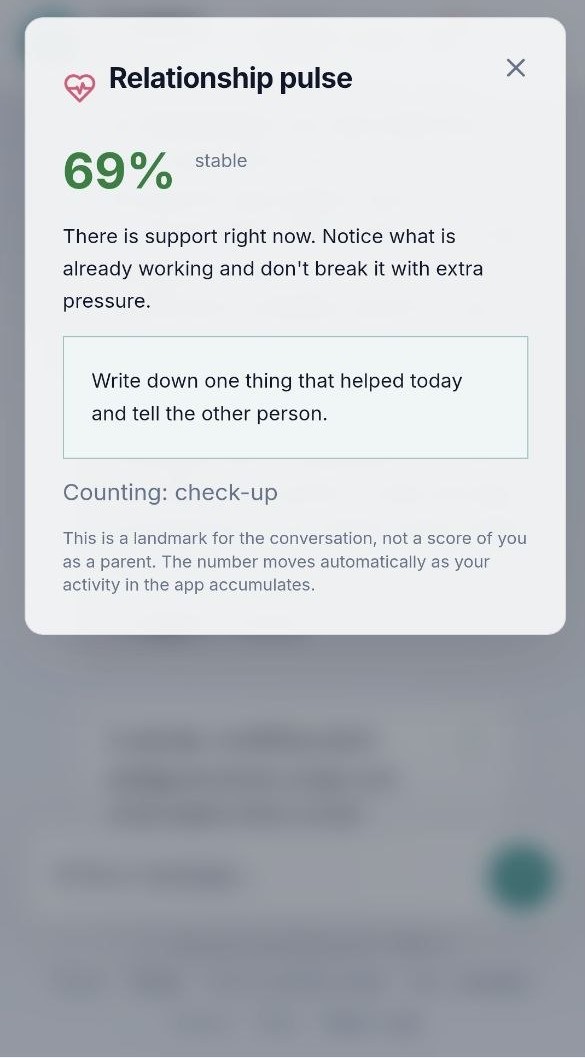
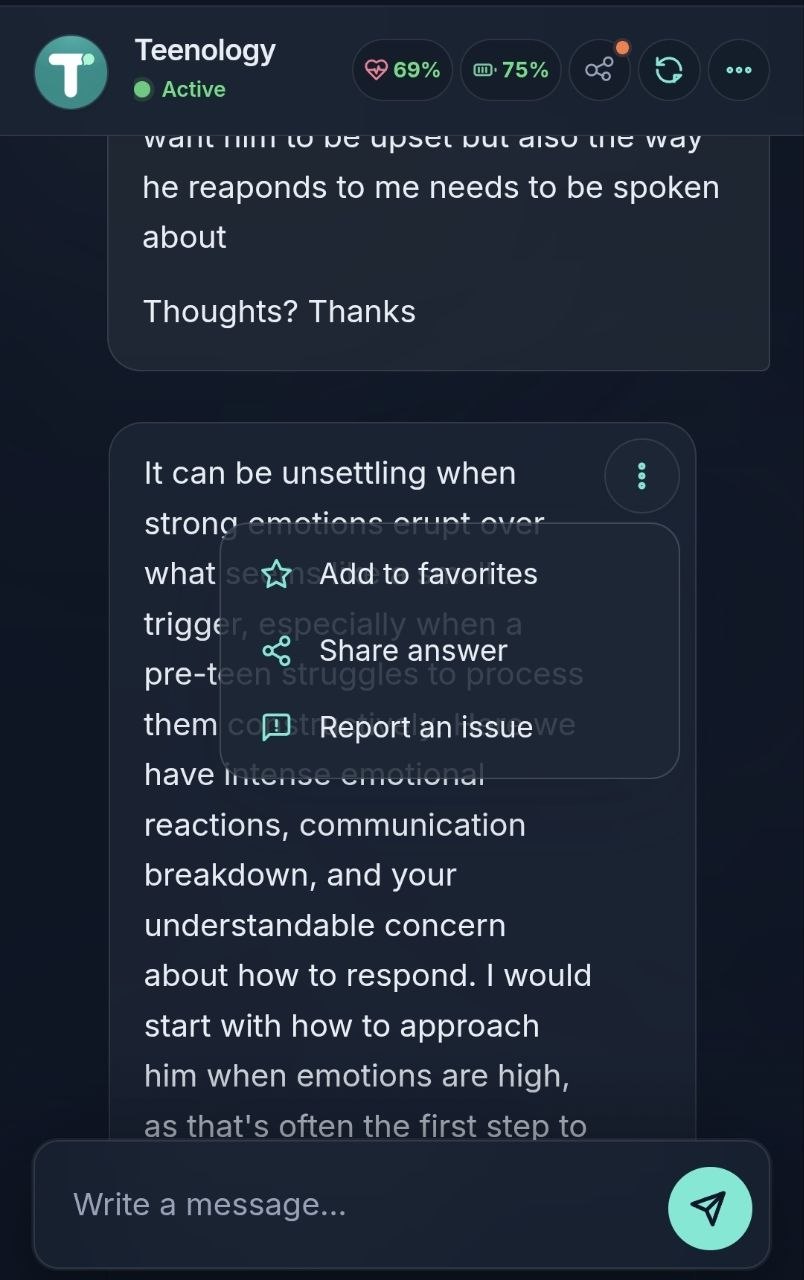
An “ECG of communication”—updates from check-up and chat; three plain-language bands, not a parent grade.
A production parent–teen PWA built for prevention and de-escalation—not clinical diagnosis, not surveillance. Families start with a free entry check-up; deeper AI support and mediation are available when they are ready.
Live captures from teenology.care. Tap Full screen on any shot to zoom.
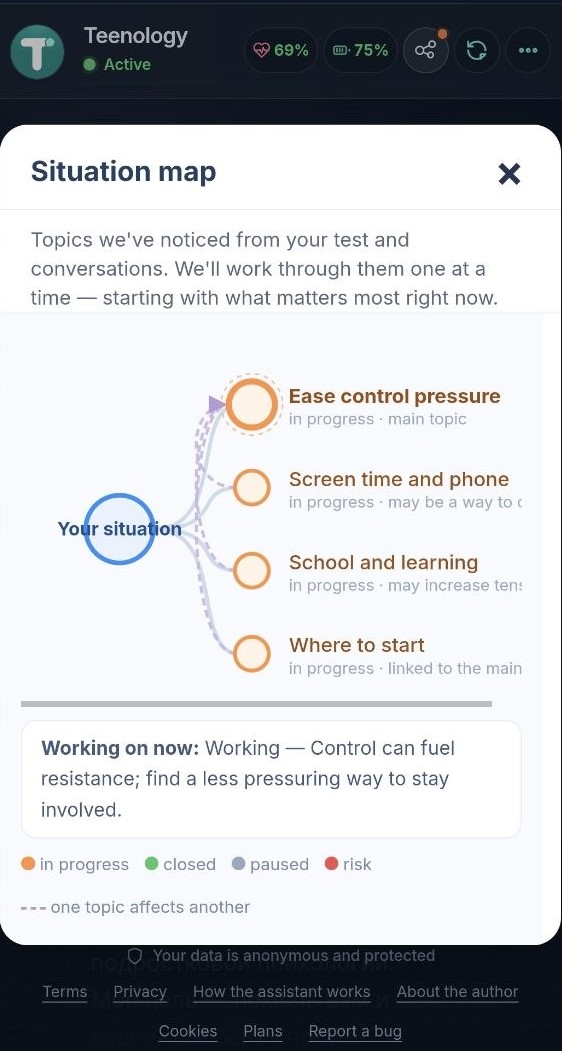
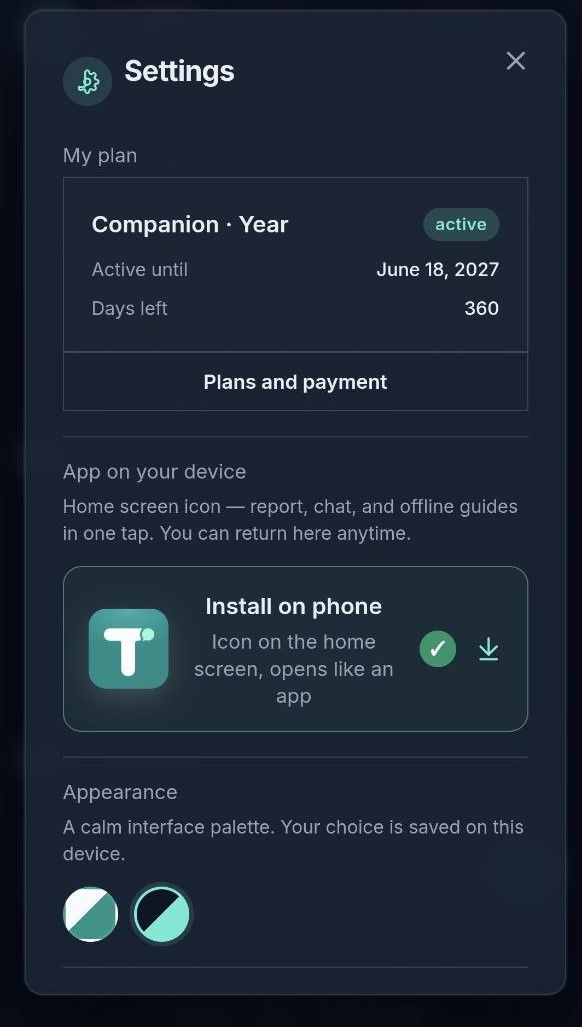
Western parents often reject “parental control” apps that feel like surveillance. Teenology is built the opposite way: communication on equal footing, not monitoring.
Surveillance apps monitor devices, relay messages, score children, and punish. Teenology gives each person a private AI coach, keeps Family Bridge chats separate (Privacy Shield), tracks progress through plain-language Pulse/Battery landmarks—not rankings—and moves toward one micro-step at a time.
Tagline: “Finally an app that helps us talk—not one that watches my kid.”
No points, streaks, leaderboards or XP. Families get a sense of movement through:
An “ECG of communication”—updates from check-up and chat; three plain-language bands, not a parent grade.
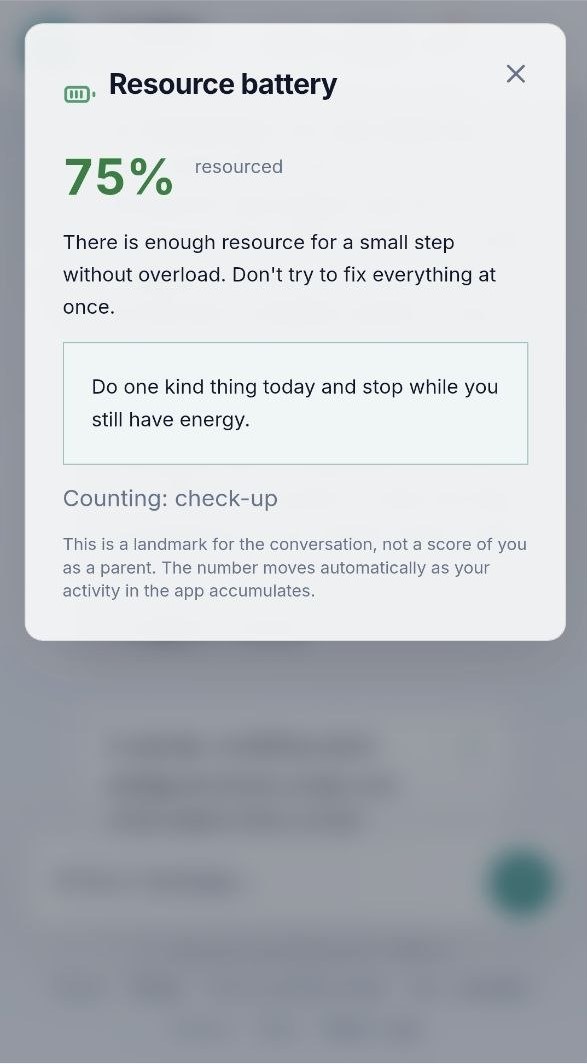
Inner energy landmark—prompts rest before big talks when resource is low.
One focus problem at a time; context-aware quick-reply chips keep dialogue moving; sprint feedback closes each cycle.
The default onboarding path is a short, structured prevention check-up—not clinical diagnosis and not open-ended chat.
After a few guided questions, the family receives an express map of the situation, a Relationship Pulse and Resource Battery (three plain-language states, not scored rankings), attention zones, and one actionable step for today.
This is positioned clearly as prevention guidance, not a medical or psychiatric diagnosis.
Teenology is positioned for families and teens as communication and de-escalation support. It does not replace licensed clinicians, school psychologists, child protective services, or emergency responders.
The product owner provides software with safety routing; human professionals and official services remain responsible for suicide risk, violence, abuse, and medical emergencies. In-app copy states that the AI companion is not a therapist and cannot guarantee safety.
When language crosses deterministic risk thresholds, the LLM path is stopped. Harm concern (e.g. self-injury without immediate lethal intent) → stabilization and therapist framing, calm next-step chips. Acute crisis → locale-aware emergency lines (112, 988, child helplines, Samaritans)—not continued AI counselling and not one-size-fits-all 911 alarmism.
Structured micro-steps, phrase cards, and bounded chat—not psychotherapy, diagnosis, or treatment plans. Teens and parents use separate role-aware flows; Family Bridge does not relay private messages between parties.
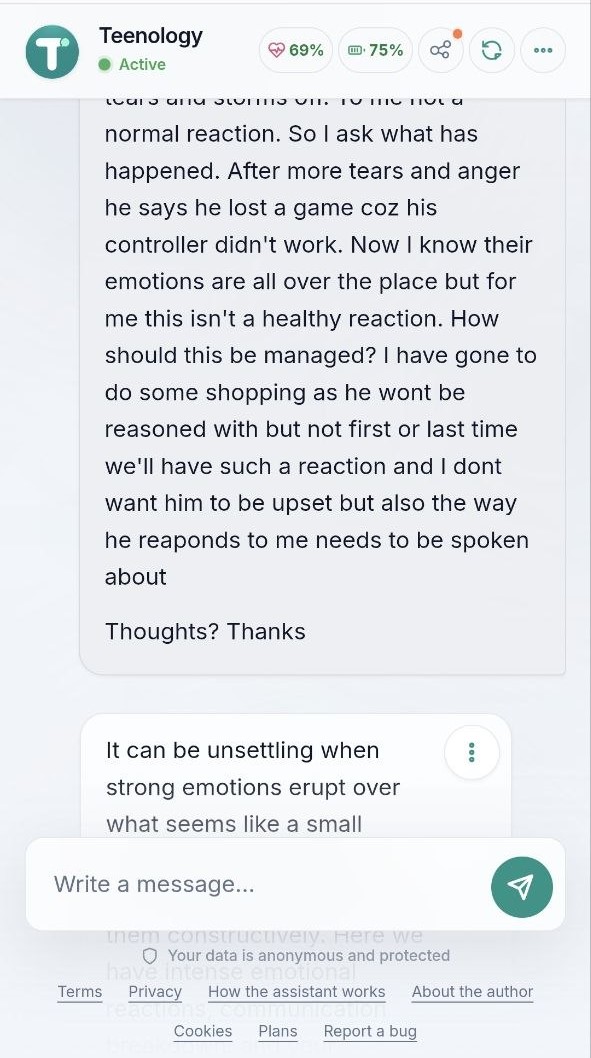
Role-aware chat for parents or teens—not psychotherapy. Guided sessions keep one current case/sprint focus: identify the main problem, avoid generic reassurance, move toward one concrete micro-step or ready phrase. Context-aware quick-reply chips adapt to sprint phase and crisis tier.
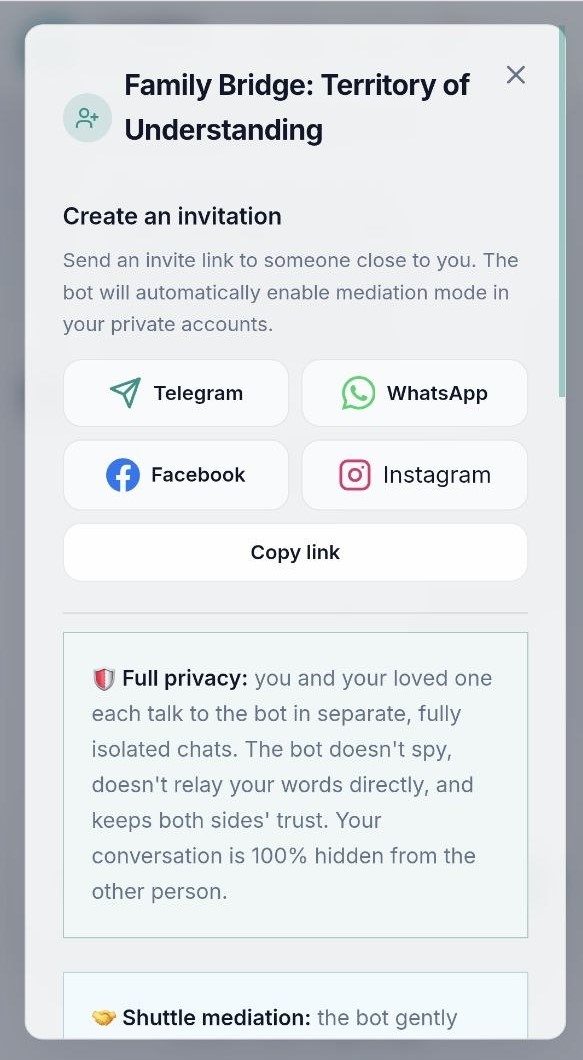
Invite the other side by link. Each person speaks with their own assistant instance. Shuttle mediation—reducing blame, surfacing needs, bounded next steps. Privacy Shield enforces in code: no direct quotes or raw chat sharing across roles.
Paid users can share a bot reply with others facing similar situations. Context is generalized—no names, no quotes from the private chat. Recipients get free follow-ups about their own situation.
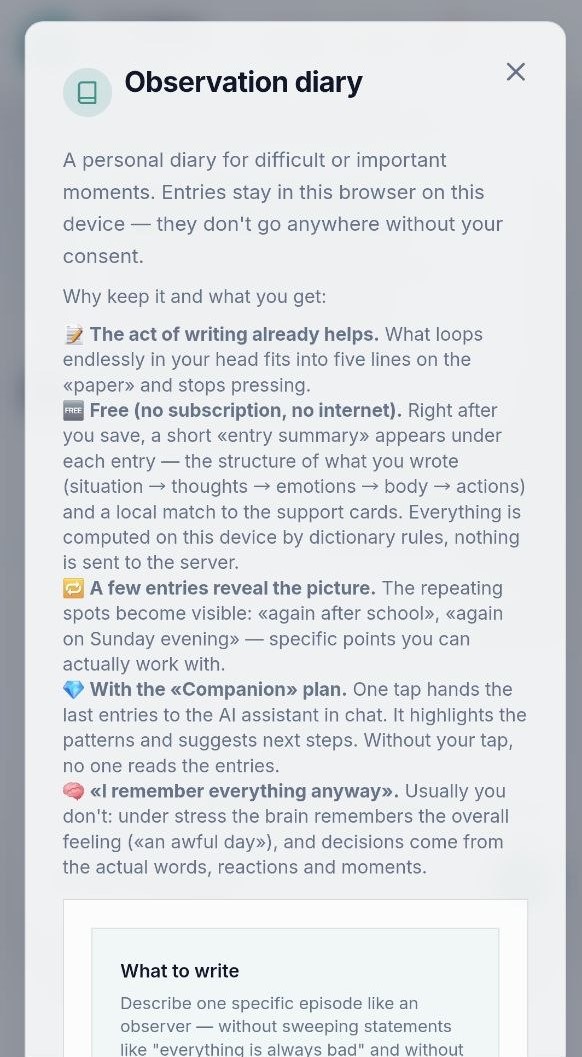
Structured observation log stored on the device. Entries stay local unless the user explicitly shares context with the AI layer.
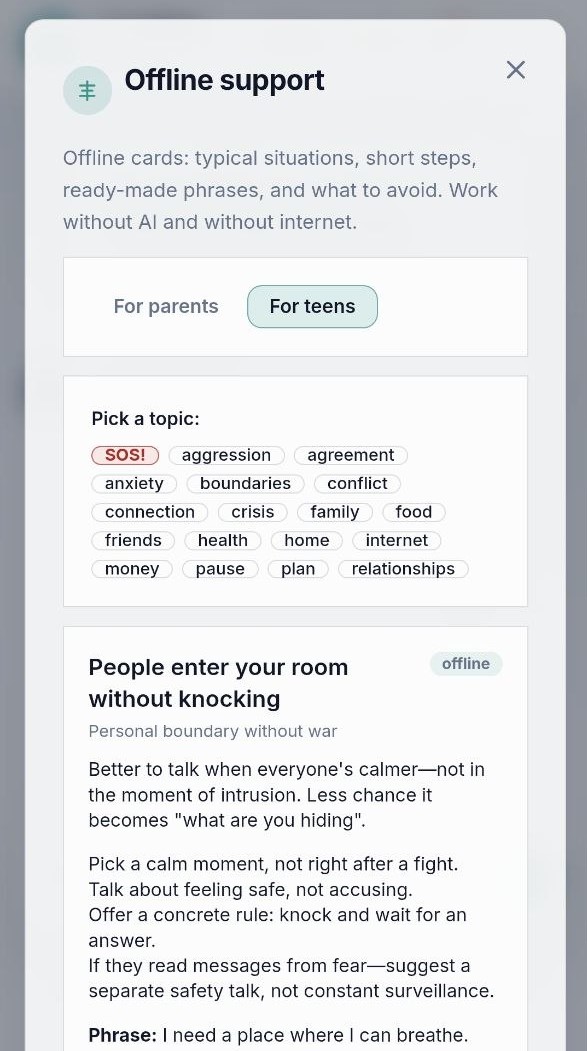
Scenario-based phrase cards and micro-steps for parents and teens, including SOS blocks—available without network via the installed PWA.
Harm concern vs acute danger get calibrated responses: stabilization copy, therapist framing when appropriate, locale-aware emergency contacts when risk is immediate.
Free tools work with minimal data exchange. Deeper features require account sign-in; diary text is not uploaded by default.
Relationship Pulse and Resource Battery update from the initial check-up, follow-up chat sessions, and optional diary patterns—designed as continuous family outcomes, not a one-time quiz score.
Product analytics use categorized problem types and intervention patterns only; family chat content is not exported for territorial dashboards.
Free relationship check-up, offline tools, and paid AI companion at teenology.care.